Posts

Modern Data Stack Simply Refers to Data Integration and Analysis

Image
One of the key characteristics that distinguishes these technologies as "current" ones is the fact that every tool in the stack is cloud-native. The information is then modified within the data warehouse so that data scientists and business users may use it more efficiently. Despite changes in data processing volume and speed, the necessary components are still controlled in a similar manner. This usually involves modelling the data and creating a few aggregate or structured analytic-specific tables out of some of the other tables in the warehouse. Current stacks are still gathering data that needs to be processed, transformed, and visualized . The phrase " Modern Data Stack " simply refers to a collection of technologies used by tech-savvy companies for data integration and analysis. Additionally, businesses may now acquire information more rapidly and effectively because vast tech stacks are no longer required to be constructed in-house. The switch from clumsy m...

The Concept of Decision Intelligence in Artificial Intelligence

Image
Intelligent decision making is an engineering discipline that complements data science with  social science theory, decision theory, and management science. Its application provides a framework for best practices in organisational and process decision-making to apply machine learning at scale. The basic idea is that decisions are based on our understanding of how actions lead to results. Smart decisions are a discipline for analysing these chains of cause and effect, and decision modelling is a visual language for representing these chains. Smart decisions are a discipline for analysing these chains of cause and effect, and decision modelling is a visual language for representing these chains.  Decision Intelligence (DI) solves the world's most complex problems or the toughest problems, as they say. It connects human decision makers with technologies like machine learning, AI, deep learning, visual decision modelling, complex systems modelling, big data, predictive analytics,...

The Role of Decision Intelligence in Pharmaceutical Life Sciences

Image
Decision intelligence is a data-driven process that allows you to quickly make faster, more accurate decisions, based on facts instead of relying on your intuition or instincts. Decision intelligences combine various decision-making techniques with AI, ML, contextual intelligence and automation to create actionable and concrete business proposals that can be deployed instantly to create business value, thereby solving the final leg of the analytical challenge. Decision Intelligence does not replace people in the decision-making process, but increases their ability to make better and more consistent decisions. As ID becomes central to business processes, decisions are made faster, easier, and more cost-effectively than ever before. The biotechnology, pharmaceutical and life sciences industries are subject to rapid changes in consumer preferences, changing supply and demand, and frequent innovation.  Decision intelligence extends an organisation's ability to use massive amounts of d...

Marketing with Augmented Analytics - Different Ways to Make it Work

Image
A variety of data processing methods, including data mining, statistical modelling, and machine learning, are put to use in augmented analytics to analyse a variety of historical and current data in order to enhance data exploration and analysis. In order to model customer behaviour, identify trends and anomalies, and develop predictions that allow organisations to act on them rather than instinct, it achieves this by using complex algorithms to data. This "enhances" how businesses can use data for more in-depth analysis in business intelligence applications. To improve decision-making, Augmented Analytics automatically identifies and highlights the most significant business insights or changes. Compared to manual approaches, it completes this task quickly. One of the main advantages of augmented analytics and other artificial intelligence-based technologies is this degree of automation and process speeding. By answering the most crucial questions, often even before they ari...

Using Technology to Improve Decision Intelligence

Image
Smart Decisions enables businesses to use AI and data to make fast, accurate, and consistent decisions while addressing certain business problems and needs. It helps to collect and model data using machine learning  to predict accurate results to make optimal business decisions. Decision Intelligence is not about removing humans from the decision-making process entirely. It's about empowering people with AI and a more accessible, comprehensive view of all  their business data to enable them to make the best decisions possible. It enables companies to process and predict using data to make more informed decisions at all levels of the business – and gain better visibility into their operations while driving Game changer business results. Smart Decisions is a field of practice that frames a broad range of decision-making techniques that bring together a number of traditional and advanced principles for designing, modelling, orchestrating, implementing, monitoring, and regulating...

Decision Intelligence Reduced the Complexity of Decision-Making Platforms

Image
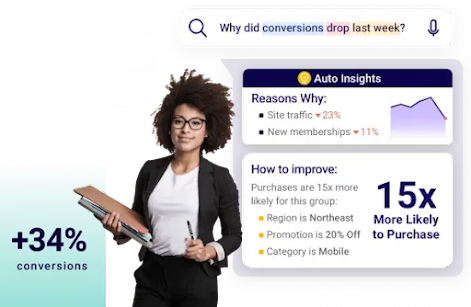
33% of important organisations will use decision intelligence in 2023, according to Gartner, which has named it one of the Top Strategic Technology Trends for 2022. Thanks to this technology, businesses of all sizes can now make data-driven decisions and provide every employee with access to cutting-edge AI-powered insights (even those without technical expertise). Business and analytics leaders should be aware of Decision Intelligence , as well as its importance and possible applications. Best-in-class decision intelligence platforms significantly reduce the complexity of decision-making by transforming business questions into natural language, applying the appropriate algorithms (statistical, classification, and regression) in the most effective way (in-memory or pushing down queries to where the data is stored), and providing users with results in a format that is understandable and helpful for taking action (using natural language generated narratives and embedding). With AI-Driv...

Decision Intelligence Relies on Analytics and Powerful Reduction Algorithms

Image
Our term "decision-maker" refers to the person in charge of decision architecture and context framing rather than the investor or stakeholder who rushes in to veto the project team's plans. In other words, someone who creates carefully worded objectives rather than someone who destroys them. It is a fairly linear and iterative process. Days, weeks, or even months after the original data collection, decisions may be made. Additionally, forecasting results heavily relies on performance and behavior  from the past. An engineering subject called decision intelligence adds theory from social science, decision theory, and managerial science to data science. Decision Intelligence includes  recommendation engines that use analytics and powerful reduction algorithms to predict consumer affinity and disposition to a certain product or service.  In addition to techniques for implementing machine learning at scale, its application offers a foundation for best practices in corporate...